Showing posts with label Retailers. Show all posts

Thursday, October 17, 2013

Gap "Back to Blue" Great Insights, Questionable Execution

Gap has made a huge investment behind it's back-to-school campaign, which is called "Back to Blue" and focuses on promoting its denim business.

I'm a big supporter of Gap focusing its marketing efforts on core wardrobe categories like denim or khakis because I believe these are the type of items the retailer is famous for and has the most right to win with. I also really love the "Back to Blue" tag-line, not just because it fits with denim theme, but also because Gap = Blue and it signals Gap's resurgence in many consumers' minds driven by a strong turn around strategy over the last several quarters.

However, I do not believe the execution of the Back to Blue campaign is on equity for Gap. Take a look at some of the campaign imagery....


The imagery just does not say Gap to me, it looks much to hipster versus mainstream All-American. It's fine if Gap wants to start evolving its imagery to have a bit more personality, but it cannot just jump there too quickly. Perhaps a more preppy hipster look might work to bridge to Gap's equity but the slightly disheveled, glassy-eyed, slouched over look just does not fit with the Gap of today. I think the brand is reaching too far and risks alienating existing consumers as well as coming off as a poser brand to true hipsters.

Gap CM Seth Farbman explains that "The entire Back to Blue campaign embodies what it means to be comfortable in your own skin".  This might be case, and I can see this attitude come to life in the imagery, but it doesn't mean the execution is done in a way that is consistent with the brand equity. Great campaign insight, great tag-line, poor execution. That's my view at least. We'll see what the consumer says. At the very least, Gap should see a bump from fielding its first TV ads in 4 years.

Thursday, June 13, 2013

JCP, I mean jcpenney

After months of significant sales declines under the leadership of Ron Johnson, Mike Ullman is back in the CEO chair at jcpenney.  Ullman now has the tall task of steering the retailer back to growth.

While most of the attention surrounding Ron Johnson's downfall has been linked to his botched attempt to move from a high-low pricing strategy to every day low pricing, another critical factor that led to the struggles was Johnson's push to try to win with a younger, more fashion forward consumer that jcpenney traditionally never had much traction with. The push included discontinuing several of the retailer's own brands and revamping the marketing strategy to appear more cutting edge, by featuring young, slim models sporting fashion forward outfits. However, this move alienated some of jcp's loyal consumers, leaving many for them feeling that jcpenney was no longer a retailer for them.

While Ullman has only been back for a brief period, there's no doubt he recognizes this mis-step is actively working to win them back. He's moving quickly to turn around the ship, for example in the matter of 2 months he's apologize, brought back old brands, invited consumers back, thanked consumers for returning, and launched a new home goods department. It's ambitious, but the tone and approach for the most part has been right on target:
  1. He apologized to his consumers in a campaign called "Yours Truly" where the voiceover read:"It's no secret, recently jcpenney changed. Some changes you liked and some you didn't, but what matters from mistakes is what we learn. We learned a very simple thing, to listen to you. To hear what you need, to make your life more beautiful. Come back to jcpenney, we heard you. Now, we'd love to see you"                                                                                                      
  2. He's brought back St John's Bay, a private label brand brought that use to account for over a billion dollars in annual sales. "We heard you. St. John's Bay is back! What will you snag first, pants or shirts?" the brand posted on Facebook
  3. He ran an advertisement reminding consumers of jcp's brands and inviting consumers back.  Listen to the end of this ad "So come back to jcpenney and save on his favorite brands. We'd love to see you"                                                                                                                                     
  4. He also ran an ad educating that jcp recognizes they screwed up, but has corrected itself and thanks consumers for returning (potentially a little bit premature)                                                                                      
  5. While he's moving forward with many elements of Ron Johnon's home goods department makeover, the execution is done in a way that is homy and connects authentically                  
However, a lot more work remains and there will no doubt be some awkward moments during the pivot back to the brand roots.  For example, I just received jcpenney's father's day catalog and there are several inconsistencies that make it appear as if the cover was just slapped on at the last moment, including:
  1. The logo on the front is "jcpenney", where as everywhere else Ron Johnson's "jcp" in a box logo still appears
  2. The cover says "It's all about you, dad", however many of the models in the catalog (including the ones on the first page) look like they are maybe 20 years old and are wearing styles that are all very slim cut and too fashion forward to be for most of the fathers I know
  3. While Ullman has moved quickly to restore sales and discounts, the catalog takes that to the extreme. Every page is tattooed with several value message, from a $10 off coupon, sale prices highlighted in red vs. original prices, % off claims, buy one get one offers, and value pledges. The result is an overwhelming barrage of promotions that looks like a design agency translated a marketing brief too literally
It's an awkward execution and highlights the challenges brands face as they try to jump from one strategy to another quickly. While there is no doubt that Ullman has to move quickly, the brand is stuck in a transition period that is blurry will likely continue to confuse the consumer until jcpenney has the time to get its feet under itself and resources aligned to return to a consistent brand position and execution. 

Thursday, September 6, 2012

Consumer Good Manufacturers Are Going Retail

Consumer product good manufacturers are going retail.  Not sure when it started, but as an ex-P&Ger I'll give Procter & Gamble credit for starting the trend a few years ago with the launch of Tide Dry Cleaners and the Mr. Clean Car Wash
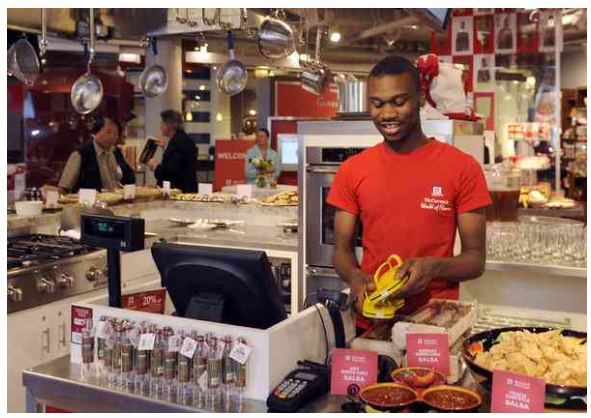
In the last few months this trend of CPG manufacturers opening their own retail stores appears to have accelerated.  McCormick recently opened a store in Maryland...

...while Dannon and Chobani have both opened up restaurants in New York City...

...and now Barilla, yep the pasta company, has also announced it will open its first restaurant.

So, what's behind this invest in retail outlets?  It's an attempt for brands to take stronger control of their value chain by owning the customer experience at point of purchase.  It also gives manufacturers a way to present, as well as boost, their brand equity in ways that aren't possible in a traditional grocery store.  Finally, it allows brands to uncover new consumer insights by directly interacting with its end users, test new products, and drive awareness.  Apparel brands have been doing this for years as they have understood the value of protecting their brand image and promoting the lifestyle aspect of their brands.  As brand experience continues to become a more important aspect of marketing, I'd anticipate this retailing trend continuing.

Tuesday, August 7, 2012

Coming to a mall near you . . . your grocery store?

As malls try to fill the empty real estate left behind from failing big box retailers such as Borders, Circuit City, Sears, etc...more and more mall landlords are looking to grocery stores to fill the void.

Grocery stores bring traffic and regular visits while not cannibalize sales from exiting retailers.  Target was one of the first stores selling grocery products to step into this opportunity, but more recently Trader Joe's, Whole Foods, and other more traditional grocery stores have also taken advantage of an existing consumer base and the ability to negotiate favorable rent terms as malls seek tenets willing to lease larger stores.

Obviously, these grocery stores have to realize they are unlikely to pull in too many convenience shoppers who would be resistant to dealing with mall traffic and tough parking.  Therefore, its important for these grocery stores to consider a dual location strategy - e.g., both on and off mall property to successfully grab as much market share as possible.  But nevertheless, seems like a win-win.

Monday, August 6, 2012

Amazon to surpass Wal-Mart?

Some retail experts are predicting Amazon will surpass Walmart as the largest retailer by 2020.  According to yahoo finance, Amazon reached $54 billion in revenue last year vs. Wal-Mart netting $455 billion in revenue - so its anything but a sure bet.

However, there's no doubt that Amazon has dramatically changed the way that many American's shop.  On big ticket items, Amazon stole the show by allowing consumer to skirt paying sales tax - although that advantage is ending shortly in many states.  Then there was Amazon Prime, free 2 day shipping on anything with an annual $50 membership.  Rumor has it, Amazon's next big game changer is going to be same day shipping on most items.  Think about that revolution.  Amazon is without a doubt changing the retail equation and a shift in the balance of power is already underway and their loyal army of shoppers is growing especially with millennials.

Retail giants have risen to dominance only to have fallen in the past (e.g., Sears), so I don't doubt the shift and the very really possibility that Amazon could overtake Wal-Mart in the next 8 years. Still, I for one think there will always be a major role for traditional brick and mortar stores.  Americans are consumers, they like to shop, they like to browse, they like to stumble on surprises and find new items they never knew they needed.  So, it all comes down to how does Wal-Mart react to the obvious shift in momentum.  Do they stay the course and bunker down or adapt and make they're customer experience irreplaceable?  If so they better get started today because the customer experience is a detriment today

Saturday, July 7, 2012

Best Buy have a showroom problem?


It's no secret that Best Buy has had many business challenges lately as the chain faces declining sales and potential door closures.  Many analysts have pointed to showrooming for online vendors as one of the major culprits of Best Buy's woes.


Showrooming is the concept that consumers browse a product in a traditional brick-and-morter store, only to purchase it online at a cheaper price.  The primary case study of showrooming has aways been consumers browse and compare TVs in person at Best Buy and then ultimately purchasing online at Amazon where they traditionally haven't had to pay sales tax.

A recent analysis of the Stevenson Company’s TraQline market studies by the Consumer Electronics Association shows that while showrooming may be allowing Amazon to cannibalize customers away from Best Buy, its actually other brick-an-morter stores that appear to be more of an issue.

The study suggests that when it comes to purchasing a new TV, 48% of all TV shoppers visited Best Buy to browse the TV section.  Of these shoppers, over half (56%) ultimately purchased a TV at Best Buy, while 44% ultimately purchased somewhere else.  So where did these consumers purchase their TVs?  The TraQline data suggests that of the shoppers who visited Best Buy, but purchased a TV elsewhere: 
  • 31% purchased at Walmart
  • 9% purchased at Costco
  • 8% purchased at Amazon
  • 7% purchased at Target
So, while Amazon is siphoning of 8% of purchasers and one would expect that number to continue climbing, the data clearly indicates that Best Buy has larger challenges than showrooming for online vendors.  The data suggests Best Buys value equation is less compelling than many competitors.  As Best Buy continues to lose shoppers to multiple competitors that consumers feel offer better value, it needs to reexamine its overall value equation and better define its proposition for consumers.

Wednesday, June 20, 2012

Walgreens meet Boots

Walgreens announced it is buying a 45% ownership stake in European pharmacy giant Alliance Boots GmbH for $6.7 billion, with an option to buy the entire company before 2016. Together the two chains will operate more than 11,000 drugstores in the U.S., Europe and Asia, under the Walgreens and Boots banners.  While investors appear concerned with the deal as Walgreens stock slide 6%, here's why I like the deal:
  • Allows Walgreens to bring Alliance Boots' strong private label stable of products to the U.S., including No7, which is the United Kingdom's leading skin-care brand. Its interesting that while the US drug store industry average private label penetration rate is only about ~14% (30% in healthcare), industry sources suggest Boots PL penetration rate is > 40%. Now some of this delta is due to differences in consumer psychology, but nonetheless, Boots' products and expertise should be an infusion for Walgreens. Walgreens has executed this strategy, albeit on a much smaller scale, following its acquisition of Duane Reade, a New York City based drugstore, which brought them "Delish", a premium private label food brand. So this move allows Walgreens continues to build its stable of exclusive brands that both have good consumer pull and high margins, while enhancing its value equation as according to SymphonyIRI’s recent Brand and Retailer Loyalty survey, >80% of consumers feel that store brand products are equal to or better than national brands when it comes to quality and packaging, while 95% feel that store brands provide a better value than national brands.
  • Makes Walgreens the largest single purchaser of prescription drugs in the world, creating significant buying power to increase margins on the the most profitable part of the store already
  • Creates the largest global pharmaceutical wholesale and distribution network with more than 370 distribution centers delivering to more than 170,000 pharmacies, doctors, health centers and hospitals across 21 countries
  • Boots also gives Walgreens access to emerging markets like China.
Now it's tough to say from an outsiders perspective if Walgreens paid too much for the deal, but the merger at least opens up a realm of both top and bottom line possibilities.

JC Penney Changing Course?

After only 8 months on the job and in the midst of JC Penney's rebranding/turnaround efforts, Michael Francis, president, responsible for merchandising, marketing, planning and allocation, product development and sourcing has "resigned". Francis who was handpicked by CEO Ron Johnson based on their experience working together at Target had been Target's Chief Marketing officer prior to moving to JC Penney.

As President at JC Penney, Francis was technically responsible for the marketing of a controversial new pricing plan that aims to get rid of hundreds of sales events, as well as, merchandising and product development. However, many outsiders claim it was actually CEO Ron Johnson who was the architect of the new pricing plan. With the turnaround under performing expectations and JCP backtracking on a portion of their strategy, the resignation appears to be a way to buy time with investors - although shares did drop 6% after the news of the resignation became public. In the same press release, Johnson announced he will take direct responsibility and oversight of the company’s marketing and merchandising.

Three things pop to mind with this latest twist in the JCP saga:

(1) Turnarounds/brand restages are never quick and easy, business results usually get worse as a company invests in the future and consumers adjust their habits/practices. Being a public company sometimes creates a barrier to delivering long-term sustainable change because of this short-term pain.  JCP should expect at least 3-4 quarters of pain at minimum assuming they're doing everything right, and a lot longer if they are mis-firing on their strategy.

(2) Turnarounds must be based on significant consumer insights and must pivot off of a solid brand foundation as opposed to try to leap to a totally new brand equity - in other words the best brand restages are evolutionary not revolutionary. Additionally, the relaunch need to be communicated in a manner that consumers understand and in a fashion that's consistent with the consumer insights its based on. It appears to me that JCP is trying to leap too far too quickly and would be better served making a series of pivots.

(3) The CEO is not usually the best person to lead a consumer driven marketing strategy because they are usually the person in the organization farthest removed from the actual consumer.  Here's to hoping that Johnson relies on people closer to the consumer to help guide the strategy and commercialization.

The JCP turnaround efforts will be a fascinating story to continue to follow as its likely to be a long/winding rode for the near future

Tuesday, June 12, 2012

Investment Thesis - Making Toys R' Us fun again

Toys R' Us was founded in 1948 and went on to become the biggest toy retailer in the US. But by the mid-2000's, Walmart, Target, Amazon, Big Lots, and Dollar Stores had jumped into the game and all cut prices on toys forcing many toy stores out of business. Facing declining sales Toys R Us was taken private in 2005 by KKR, Bain Capital and Vornado Realty Trustin a $6.6 billion deal.

Under private ownership, Toys R' Us tried to remain a relevant player in the toy industry by increasing private label and exclusive toys at the retailer. The company also bought KB Toys, eToys, and F.A.O. Schwarz. The company also converted ~25% of its locations into combined Toys R' Us and Babies R' Us stores. These moves were an effort to protect itself from competition and drive traffic into the stores.

However, these points of difference have not proven sufficient to fully stop the bleeding. The competitive pressures facing Toys R' Us continues to intensify and as its Private Equity owners consider an IPO, its time for consider options for future growth of its toy business. More specifically, given Toys R' Us is being cannibalized by both low cost vendors as well as more convenient vendors and the shift to a more exclusive assortment mix and co-locating doesn't appear to be sufficient, the company needs to find an additional factor that will draw customers into the store.

A solution is to dramatically change the in-store customer experience in order to build a stronger point of difference from competitors, to help limit price competition. One potential game changing move would be to turn the center of the store into a large play area taking the best of the playground and combining it with the best of Chuck E. Cheese, while merchandising toys around it. This play center could even potentially be turned into a revenue generator via ticket purchases. Not only would the play area would operate as a traffic driver, but also a testing ground by taking the toys out of the box and let the kids (and adults) play. For anybody who can remember walking into the original New York City F.A.O. Schwarz as a child, it would also help bring back the magic toy store once seemed to have.


The concept of "shoppertainment" has been proven out on plenty of smaller scales.  For example, Jordan's Furniture, a Boston based furniture founded in 1918 and now owned by Warren Buffett, applied this principle in one of their stores by building a Motion Odyssey Movie (MOM) theater/ride in one of there stores in 1992 and then later added an Imax theater in a different store in 2002. These moves not only created an instant traffic driver, but also a clear point of difference that couldn't easily be duplicated by its competitors.

Toys R' Us growth can come from expanding their mission from selling toys to entertaining children in and out of the store.

Friday, June 8, 2012

JC Penney offers "A Not So Square Deal"

As part of JC Penney's turnaround strategy they launched a new "Fair and Square" pricing plan at the beginning of 2012. The chain that for decades relied on multiple promotions, percent-off sales, and coupons to drive incremental consumption, has decided to put an end to all of those promotional vehicles in an effort to become less reliant on trade activity. 


This new strategy seemed to make sense given they ran 590 distinct sales in 2011 and drove 70% of its revenue from products sold at least 50% off full retail price. Rather than slowly peel back on the number of promotions, JC Penney decided to go cold turkey and rip the band-aid off with its "Fair and Square" plan, which simplifies their pricing strategy around three levels: "Every Day", "Month Long Value", and "Best Price". The "Every Day" or EDLP price was also lowered 40% vs. the prior traditional high-low pricing strategy.


The only problem is somebody forgot that consumer habits are hard to break and consumers, especially consumers of brands with weak equity and low consumer loyalty, also have very low brand engagement. The low engagement means that consumers are unlikely to realize you changed your pricing strategy in store or in your tv ads, but they will notice you no longer have sales or coupons.  Therefore, even if the absolute price in store is the same or lower, the consumers perception of the price point may actually be higher or they may not be motivated to visit your store without the promotional stimuli.


Hence, nobody should have been surprised when JC Penney announced its latest sales figures: "Comparable store sales for the first quarter declined 18.9 percent. Total sales decreased 20.1 percent, which includes the effects of the Company’s exit from its outlet business. Internet sales through jcp.com were $271 million in the first quarter, decreasing 27.9 percent from last year."


CEO Ron Johnson reacted to results by telling investors “We have work to do to educate the customer on our pricing strategy and to drive more traffic to our stores”.  Anytime a business leader or market says we have to "educate consumers" that should be an immediate red flag. I'm not a believer that consumers can be "educated", and even if they could, its going to be extremely expensive. 


If a new product or retail customer experience aspect isn't intuitive enough for consumers to figure out in a 10 seconds glance, then its not going to sell very well to mainstream mass market. This is why any good new product or brand building strategy has to start with a strong consumer insight and be brought to life in a simple manner that is intuitive.


Now, just months after the launch of the new pricing strategy, Johnson is admitting JC Penney made some mistakes. First, they layered back in 5 extra best priced Friday events, and second, announced that "We're moving away from the word 'month-long value' because no one really understood that, to calling it what we intended to do, a sale . . . Our marketing isn't doing the work . . . We've got to get our pricing across"


While this moves will likely help some, I for one am doubtful this will fix all the woes. As coupons and deals, spur incremental purchase not only because of the low price, but also because they make consumers feel like they are outsmarting their peers and adding time limitations drives consumers to act versus month-long promotions that don't feel as special.

Sunday, April 10, 2011

Gap, heading down the wrong road?

Gap's struggles over the the last few years are no secret. In 2010, the Gap division has a total revenue of $5.8 billion, well below its pre-recession revenue peak of $6.2 billion in 2007. Unfortunately, 2011 isn't looking too much brighter for the Gap division, as North American stores report a same-store sales decline of (9%) versus year ago, while many of its competitors reported stronger than expected sales. These declines are despite the fact that Gap Inc. reportedly spent $70.5 million to advertise the Gap brand over the past year, according to the Kantar Media unit of WPP.

Given these troubles, its not a surprise that Gap management has been trying to shake things up in order to reignite growth. First, Gap tried refreshing its brand image by altering its longstanding logo - this effort turned into a public relations fiasco by causing a significant consumer uproar. Within what seemed like a matter of hours, Gap reversed course and restored its old logo, but not before proving just how out of touch the fashion giant is with its core consumers.

Now Gap is back at it again, trying to put a brand-aid on its sales challenge. Gap announced last week it would refreshen its image as the "People's Brand"

http://www.nytimes.com/2011/04/08/business/media/08adco.html?_r=1

The effort is being led by Gap's new chief global marketing officer, Seth Farbman, a former advertising executive from Ogilvy & Mather Worldwide. Farbman describes the “a people’s brand” positioning as a focus on fun, optimism and value for money.

Hmmm...does this positioning raise red flags to anybody? Thinking about this positioning from both a consumer and marketers perspective "Fun, optimism and value" sounds like the company may be confusion its Gap brand with its Old Navy brand. Doesn't Old Navy owns fun and value (at least in the mind of this consumer)?

So, why is Gap treading on its own tracks? Farbman claims “This is not a five-year turnaround strategy . . . This is a right-now.” Farbman is correct in that Gap needs to “set a clear point of view for the brand”, which it has clearly lost over the past few years; but Gap is losing sight of the bigger picture by not thinking about the longterm equity of both Gap and Old Navy.

I would venture to say Gap has struggled in its consumer positioning for a few reasons. First, Gap over-expanded its brand, which has caused it to lose some of its specialness. Second, as Gap Inc.'s other brands Old Navy (position: fun and value) and Banana Republic (position: sophistication and style), have effectively sandwiched the positioning of the Gap brand in the middle making it harder to find a unique space to own.

To get back to a position of growth, Gap needs to get back too its roots and focus on the basics.  Instead of trying to chase what it is not, Gap should embrace what it is - America's brand.  What made Gap so iconic in the first place.  The positioning should be optimistic and patriotic, with a focus on selling a modern take on the classical American lifestyle (bring on the swing dancing and all) - in summary a middle class version of Ralph Lauren.