As I noted in previous posts, the yogurt wars are on center stage. . .
If the Greek yogurt market was a boxing match, Yoplait would be badly blooding coming out of the first several rounds (with less than a 10% market share). However, now the brand has come out of its corner swinging for Chobani, the Greek yogurt heavy weight champion.
In a good old fashion Coke vs. Pepsi style rumble, Yoplait is challenging Chobani to a taste test to determine who has the best Greek-style yogurt in an effort to win over consumers.
The backbone of their fight is a national TV campaign ads that doesn't pull any punches. . .
Yoplait's is also making the fight personal by opening a pop-up store in New York City very close to where Chobani's SOHO flagship operations are located. In the meantime, Chobani is counterpunching with the recent launch of its 100-calorie line, Chobani Simply 100, to challenge Yoplait Greek 100 ($150 million in sales) as well as running a Super Bowl advertisement to drive national awareness.
At the very least, Yoplait's highly-competitive actions will force Chobani to decide if it should switch from offense (in support its own new product innovation) to defense (by double down support of its base business). My viewpoint is Chobani is the category leader and it has to stay the course of dictating the terms of competition in the category. This means fixing its GMO image and celebrating its "nothing but goodness heritage" in the core business and leading the evolution to adult mix-ins behind its newest product launches. Keep Yoplait chasing you.
Showing posts with label Chobani. Show all posts
Showing posts with label Chobani. Show all posts
Tuesday, January 28, 2014

Thursday, January 16, 2014
Are Consumers Souring on Chobani? Is the Brand at a Tipping Point?
In the matter of only a few years Chobani, the leading Greek Yogurt brand in America, has transformed itself from a small challenger brand into a $1 billion power-player that is giving Yoplait and Dannon a run for their money in the dairy aisle. And in full disclosure, I'm a huge fan of how Chobani built its brand (the unique product/packaging, the challenger brand refusing to back down to the traditional yogurt powerhouses, the innovation, the CEO's vision, etc.), not to mention the delicious product. There's no doubt, Chobani's rise has been magical, with it looking like the brand could do no wrong, that is until recently . . .
Chobani has hit a number of stumbling blocks over the last few months that risk alienating core consumers and challenging the long-term health of the brand. During its meteoric rise, Chobani built a tremendous groundswell of passionate, loyal core consumers. This consumer-base allowed the brand to grow organically through strong consumer advocacy, without having to spend large sums of money on traditional marketing to compete with Dannon and Yoplait. However, there are now cracks in that consumer-base. It's astonishing how many passionate negative comments have appeared on Chobani's facebook page over the last few months. Yes, there are a ton of passionate positive ones too to offset the negative advocacy, but still its troubling for the longer-term brand health. Taking a closer look at the different brand stumbles suggests the cumulative effect of all of these stumbles should be alarming for Chobani.


Net-net, the combination of all of these brand stumbles will have a short-term impact on the business (e.g., the lost volume during the from the product recall, Whole Foods de-listing, downsizing), but more importantly, I believe they represent a longer-term tipping point for the brand where it will start losing an important sub-set of its passionate core consumers. These core consumers were likely some of the original supports of the brand, early advocates that spread word of mouth, and helped fuel the organic brand growth. These consumers shop at Whole Foods, believed "nothing but good" meant safe (no contamination) and pure (no GMOs), and were willing to pay more than traditional yogurt for Chobani because they felt like they were getting more from the brand (both literally an additional 0.7 ounces and figuratively in an emotional connection to the brand). Can Chobani win these consumers back before its too late? Potentially, but to do so would require a shorter-term financial hit to the brand. I'd anticipate these consumers finding, latching onto, and starting to champion a new premium yogurt brand in Whole Foods' dairy section and helping to start building that brand. In fact, it looks like it's already starting . . .

Chobani has hit a number of stumbling blocks over the last few months that risk alienating core consumers and challenging the long-term health of the brand. During its meteoric rise, Chobani built a tremendous groundswell of passionate, loyal core consumers. This consumer-base allowed the brand to grow organically through strong consumer advocacy, without having to spend large sums of money on traditional marketing to compete with Dannon and Yoplait. However, there are now cracks in that consumer-base. It's astonishing how many passionate negative comments have appeared on Chobani's facebook page over the last few months. Yes, there are a ton of passionate positive ones too to offset the negative advocacy, but still its troubling for the longer-term brand health. Taking a closer look at the different brand stumbles suggests the cumulative effect of all of these stumbles should be alarming for Chobani.
- Chobani issued a recall after finding a portion of its yogurt was tainted by mold, which caused over 100 consumers to become sick with symptoms including nausea and cramps. While the majority of consumers are willing to forgive and forget assuming this was a one time mistake and the company appears to have handled the mini-crisis with sincerity, events like this start chipping away at a brands trust - especially a brand with a slogan of "nothing but good". Take a read of a few of the several hundred facebook posts:
- Consumers became aware that Chobani is not sure if the grain fed to the cows producing the milk contains GMOs (genetically modified organisms). The GMO finding is very interesting because it again directly clashes with Chobani's promise of "nothing but good". As the facebook posts below illustrate, this realization is upsetting and alienating many of its core consumers. That said, the learning would be far more damaging to short-term brand sales if Chobani was still a small brand that relied on distribution from Whole Foods and other natural and premium grocery stores. Given a bulk of brand sales now come from the likes of Walmart and mainstream grocery stores, the more mainstream consumers are unlikely to blink much of an eye, at least in the short-term.
- Chobani is downsizing its product from 6.0 to 5.3 ounces, while holding price constant equating to effectively a 12% price increase. Let's just say consumers are not going to be happy about this. Look at a few comments of the hundreds from Chobani's facebook page:
- Whole Foods announced it would de-list Chobani by early 2014. Whole Foods decision to de-list Chobani is really not a surprise given both the GMO issue as well as the brand transitioning from a unique, premium product to a mainstream, mass market mainstay. Chobani grew to over $1 billion in large part by expanding distribution from Whole Foods into mainstream grocery stores, Target, Walmart, Costco, Sam's, and many other retailers. Whole Foods' strategy is to charge a premium price on a differentiated product assortment from more mainstream channels, so as Chobani grew it became at odds with this core strategy. Whole Foods actually held distribution on Chobani longer than it typically does with most brands that mainstream - likely in large part because of Chobani's loyal consumer base and the brand's initial reluctance to discount its products in traditional grocery, mass, and club channels. These combination of factors allowed Whole Foods to maintain its margin integrity. However, as the yogurt wars heated up and Chobani expanded production capacity (believe it or not for many months Chobani was actually selling faster than the company could manufacture it), it appears that Chobani has started playing the promotion game to fend off competition and win back consumers from the product recall. Overall, losing Whole Foods doesn't just mean lost sales, but is also another challenge to the brand image and keeping its original core consumer group.
Saturday, August 24, 2013
The Yogurt Wars Heat Up and YOPLAIT Appears One Step Behind . . . AGAIN
The US yogurt wars are heating up again and about to become even more intense...and Yoplait appears to be one step behind again.
For years the US yogurt market was dominated by Yoplait and Dannon. However, five years ago the US market was fundamentally changed with the emergence of Chobani, which helped usher in the Greek yogurt revolution.
As Greek yogurt mainstreamed growing from 4% of the US yogurt market in 2008 to nearly 45% in 2012, Chobani was transformed a small challenger brands into a $1 billion power-player that is giving Yoplait and Dannon a run for their money.
Dannon reacted with the 2011 launch of its Greek yogurt sub-brand Oikos. Oikos growth has been tremendous, surpassing over $400 million 2012, which is a ~45% growth from its first year sales. Not only was Dannon able to leverage the brand to grow the overall Greek Yogurt segment, but also start winning back some share from Chobani by advertising its superior taste behind a claim that Oikos is preferred 2 to 1 over the leading brand.
On the other hand, more than 2 years later Yoplait is still trying to figure out how to win in Greek yogurt. Yoplait's initial entry into Greek Yogurt was a bust...as was its first relaunch attempt in 2011. Now Yoplait, which is owned by General Mills, is hoping to make up for lost ground by relaunching its Yoplait Greek yogurt again, this time behind a new formula, packaging and advertising. In it's new TV ads, Yoplait declares that "it's time healthy gets a dose of happy" and carry the tag line "it's time to lick the lid again."


For years the US yogurt market was dominated by Yoplait and Dannon. However, five years ago the US market was fundamentally changed with the emergence of Chobani, which helped usher in the Greek yogurt revolution.
As Greek yogurt mainstreamed growing from 4% of the US yogurt market in 2008 to nearly 45% in 2012, Chobani was transformed a small challenger brands into a $1 billion power-player that is giving Yoplait and Dannon a run for their money.
Dannon reacted with the 2011 launch of its Greek yogurt sub-brand Oikos. Oikos growth has been tremendous, surpassing over $400 million 2012, which is a ~45% growth from its first year sales. Not only was Dannon able to leverage the brand to grow the overall Greek Yogurt segment, but also start winning back some share from Chobani by advertising its superior taste behind a claim that Oikos is preferred 2 to 1 over the leading brand.
On the other hand, more than 2 years later Yoplait is still trying to figure out how to win in Greek yogurt. Yoplait's initial entry into Greek Yogurt was a bust...as was its first relaunch attempt in 2011. Now Yoplait, which is owned by General Mills, is hoping to make up for lost ground by relaunching its Yoplait Greek yogurt again, this time behind a new formula, packaging and advertising. In it's new TV ads, Yoplait declares that "it's time healthy gets a dose of happy" and carry the tag line "it's time to lick the lid again."
The insight Yoplait is basing its bet on is that American consumers will prefer a less sour Greek yogurt and fruit pre-blended into the yogurt, as opposed to being on the bottom of the container. I personally, don't buy that this positioning will be enough to catch up to Chobani and Dannon, but it will likely be sufficient to remain relevant in the category.
Meanwhile, as Yoplait focuses on and invests in getting its base Greek yogurt offering right, the yogurt market is about to take its next major transformation - adult yogurts with flavor enhancing add-in.
- First Pepsi's Quaker unit launched Muller (a new joint venture with a European based yogurt company) that features an extensive line of flavor add-ins. Expect major marketing pushes behind this product over the next several months
- Chobani's answer was to launch "Flip" and "Bite" sub-lines.
- Now Dannon is jumping into the game via its recent acquisition of YoCrunch, the market leader in yogurt mix-ins. YoCrunch features 27 different varieties of mix-ins (though most are geared at kids). Not only does the YoCrunch acquisition give Dannon instant market share in this segment, but more importantly instant access to critical packaging capabilities that will eventually allow Dannon to bring this innovation to their Dannon brands.
While Yoplait does have a mix-in granola offering...
...its already a step or two behind and is going to have to quickly invest in major innovation to keep its offering competitive. But in all likelihood, Yoplait will be spending the the next few years playing catch up again. Proof a market leader can never stop innovating or it risks being surpassed.
Thursday, September 6, 2012
Consumer Good Manufacturers Are Going Retail
Consumer product good manufacturers are going retail. Not sure when it started, but as an ex-P&Ger I'll give Procter & Gamble credit for starting the trend a few years ago with the launch of Tide Dry Cleaners and the Mr. Clean Car Wash

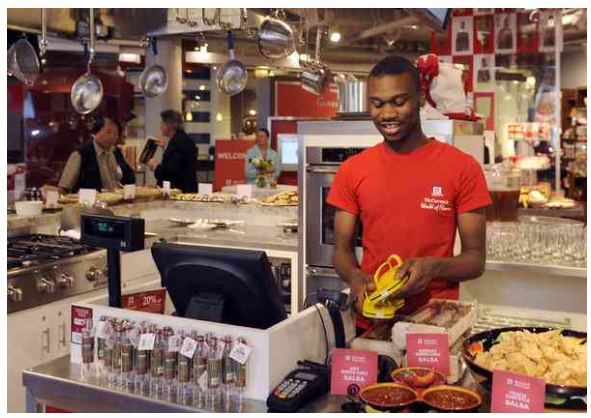
 In the last few months this trend of CPG manufacturers opening their own retail stores appears to have accelerated. McCormick recently opened a store in Maryland...
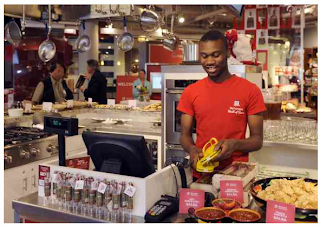
...while Dannon and Chobani have both opened up restaurants in New York City...


So, what's behind this invest in retail outlets? It's an attempt for brands to take stronger control of their value chain by owning the customer experience at point of purchase. It also gives manufacturers a way to present, as well as boost, their brand equity in ways that aren't possible in a traditional grocery store. Finally, it allows brands to uncover new consumer insights by directly interacting with its end users, test new products, and drive awareness. Apparel brands have been doing this for years as they have understood the value of protecting their brand image and promoting the lifestyle aspect of their brands. As brand experience continues to become a more important aspect of marketing, I'd anticipate this retailing trend continuing.
...while Dannon and Chobani have both opened up restaurants in New York City...


...and now Barilla, yep the pasta company, has also announced it will open its first restaurant.
So, what's behind this invest in retail outlets? It's an attempt for brands to take stronger control of their value chain by owning the customer experience at point of purchase. It also gives manufacturers a way to present, as well as boost, their brand equity in ways that aren't possible in a traditional grocery store. Finally, it allows brands to uncover new consumer insights by directly interacting with its end users, test new products, and drive awareness. Apparel brands have been doing this for years as they have understood the value of protecting their brand image and promoting the lifestyle aspect of their brands. As brand experience continues to become a more important aspect of marketing, I'd anticipate this retailing trend continuing.
Subscribe to:
Posts (Atom)