There is no doubt that the advertisement grabs your attention and pulls at your heart string, in this way its a great commercial. One could argue that despite the advertisement being memorable, it fails to drive strong brand recall. But in this case the Paper and Packaging Board isn't trying to make a branding play or even convince anybody to make a specific purchase, but rather remind consumers that there is still an important role for personalize, physical communication in an increasingly digital world.
Showing posts with label Commercials. Show all posts
Showing posts with label Commercials. Show all posts
Tuesday, April 26, 2016
The Paper and Packaging Board Creates A TV Advertisement, And It's Great!
The Paper and Packaging Board is an association I never expected to see an advertisement from, let alone get me to stop and notice it. However, that's exactly what its "Letters to dad" advertisement recently did around the campaign theme of "how life unfold". The advertisement was created back in 2015, although I only saw it for the first time this past weekend. Take a look...
There is no doubt that the advertisement grabs your attention and pulls at your heart string, in this way its a great commercial. One could argue that despite the advertisement being memorable, it fails to drive strong brand recall. But in this case the Paper and Packaging Board isn't trying to make a branding play or even convince anybody to make a specific purchase, but rather remind consumers that there is still an important role for personalize, physical communication in an increasingly digital world.
There is no doubt that the advertisement grabs your attention and pulls at your heart string, in this way its a great commercial. One could argue that despite the advertisement being memorable, it fails to drive strong brand recall. But in this case the Paper and Packaging Board isn't trying to make a branding play or even convince anybody to make a specific purchase, but rather remind consumers that there is still an important role for personalize, physical communication in an increasingly digital world.

Sunday, February 7, 2016
Toyota Prius "The Longest Chase" Best Super Bowl Advertisement of 2016
Toyota wins my award for best Super Bowl commercial of 2016 for its Toyota Prius "The Longest Chase" advertisement.
The award is based on the premise that strong advertisements grab your attention, communicate a clear benefit, link to the brand equity, and have strong brand recall. Many Super Bowl ads are entertaining and grab your attention, but few do all four of these things and hence don't move the needle in terms of driving brand perception and ultimately revenue. Indeed, many brands fall into the trap of pushing too far on the entertainment aspect and fall short on the benefit, brand equity, or recall aspects.
While the plot of the Toyota Prius advertisement is sure to stir a little controversy (e.g., potential references to OJ Simpson), the commercial was both entertaining and effective. In short, the ad did exactly what it needed to do for the brand - re-frame it as a car that is anything but boring in a way that was compelling, on equity, and memorable.
Take a look if you missed it:
Sunday, June 21, 2015
Identical Twins Chewing Gum
This came out about a year ago, but is an awesome viral commercial for Beldent Chewing Gum from Argentina. It's called "Almost Identical Twins" and is an excellent execution.
Very clever...
Very clever...
Saturday, January 3, 2015
Bud Light Recycles Coke's Label Campaign
A few years ago, Coke launched its "Share a Coke" campaign first overseas and then in the US over the past summer where the brand put the 250 most popular American teen names and other millennial sayings on its labels.
Now it looks like Bud Light is taking a page out of Coca-Cola's playbook. As part of its "Perfect Beer For Whatever Happens", Bud Light is launching new bottle labels featuring over 100 different varying messages.

Each label touts Bud Light is the "perfect beer for ... ".
For example:
The messages are suppose to help position the brand around inspiring spontaneous fun. And while the messages are fun enough, they do not have the same compelling call to purchase as consumers seeing their names on a bottle or labels such as "BFF,” “Star,” “Bestie,” “Legend,” “Grillmaster,” “Buddy” and “Wingman” like Coke featured.
Additionally, the messaging in at least one of the accompany TV advertisements fails to hit home on this core benefit because it over complicates its message by trying to communicate too many things...
The area of the campaign that has the most promise is where the brand will customize beer bottle labels sold at sporting events and concerts that allow some drinkers the chance to win random, on-the-spot prizes, such as backstage passes or other real-time rewards.
Using the beer labels as a ticket for entry into a contest or a treasure hunt is clever and I believe will be compelling enough to drive consumers at the events to purchase. The biggest question is how much scale can Bud Light generate with event based programs and will it be enough to generate sufficient social buzz to drive a noticeable lift in sales? The other question is why didn't the brand aim bigger? It seems like the brand could replicate this strategy on a much large scale with a McDonald's like Monopoly game where the notion of spontaneous fun can support itself organically.
Now it looks like Bud Light is taking a page out of Coca-Cola's playbook. As part of its "Perfect Beer For Whatever Happens", Bud Light is launching new bottle labels featuring over 100 different varying messages.
Each label touts Bud Light is the "perfect beer for ... ".
For example:
- "the perfect beer for when you're eating breakfast meats outside of breakfast hours"
- "the perfect beer for forming a one-person conga line"
- "the perfect beer for leaving your comfort zone in another time zone"
- "the perfect beer for taking off the blindfold and showing that piñata who's boss"
- "the perfect beer for tuning up the old air guitar"
The messages are suppose to help position the brand around inspiring spontaneous fun. And while the messages are fun enough, they do not have the same compelling call to purchase as consumers seeing their names on a bottle or labels such as "BFF,” “Star,” “Bestie,” “Legend,” “Grillmaster,” “Buddy” and “Wingman” like Coke featured.
Additionally, the messaging in at least one of the accompany TV advertisements fails to hit home on this core benefit because it over complicates its message by trying to communicate too many things...
The area of the campaign that has the most promise is where the brand will customize beer bottle labels sold at sporting events and concerts that allow some drinkers the chance to win random, on-the-spot prizes, such as backstage passes or other real-time rewards.
Using the beer labels as a ticket for entry into a contest or a treasure hunt is clever and I believe will be compelling enough to drive consumers at the events to purchase. The biggest question is how much scale can Bud Light generate with event based programs and will it be enough to generate sufficient social buzz to drive a noticeable lift in sales? The other question is why didn't the brand aim bigger? It seems like the brand could replicate this strategy on a much large scale with a McDonald's like Monopoly game where the notion of spontaneous fun can support itself organically.
Sunday, February 3, 2013
M&M's: My Favorite Super Bowl 2013 Ad
Well done M&M's for being my favorite Super Bowl 2013 TV Ad.
Officially titled M&M's "Love Ballard" commercial. The commercial featured "Glee" star Naya Rivera and Red M&M, with a Meat Loaf classic song playing in the background. Take a look...
Not only is the Ad humorous and entertaining, but it also sold the product benefit and had strong brand linkage - two important criteria many Super Bowl commercials forget about.
Wednesday, August 8, 2012
Who are the Olympic Advertisers and Sponsors again?
A new consumer study completed by Toluna Global Omnibus illustrates that consumer awareness and recall of what companies are Olympic sponsors and advertisers is surprisingly low. The graph below illustrates the brand recall by company (unclear if this is aided or unaided awareness):
 There are two notable take-aways from the data above.
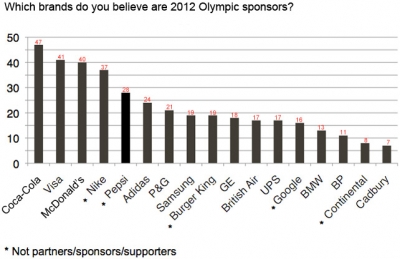
- 5 of the top 16 companies (including 2 of the top 5) got credit for being a sponsor without actually spending a dime on Olympic advertising
- Even Coca-Cola, the brand with the most recall, has shockingly low awareness of sponsorship, with less than 50% of consumers aware of the linkage to the Olympics, and 28% of consumers crediting their ads back to primary rival Pepsi
These data points bring two thoughts to mind, first the investment in sponsorship doesn't seem to equate to a considerable amount of revenue upside. Second, brands are really doing a bad job of differentiating their advertisements and breaking through to drive recall.
I posted a few days ago about how many Olympic ads all seem to blend together, so check that post out if you haven't and watch the three example ads in that post.
Ragu TV Ad Double Take
When a kid catches his parents in bed, Ragu can help? What? That's right, Ragu, the pasta sauce company, recently launched a new TV ad campaign bringing a bit of humor and shock value to break through and get noticed. The ad is titled "A long day of Childhood calls for America's favorite pasta sauce". Take a look...
First, the ad is hilarious and shocking, especially for an ad the made its debut during the family friendly Olympics - so it without a doubt will clearly breaks through and gets noticed. There is also likely good brand recall, because it is is very unique, has solid branding, a catchy little jingle, and the drama at the beginning of the ad keeps you watching all the way through. However, it doesn't exactly make me want to buy pasta sauce - if anything it makes me lose my appetite a little bit. The big question is does the ad go too far? Also does light and funny humor go with a thick and chunky pasta sauce? Maybe I'm over thinking this one.
New research by ad-testing firm Ace Metrix proves that while funny ads may get high marks, funniness had little correlation with effectiveness and in fact, funny ads were slightly less likely to increase desire or purchase intent than unfunny ones
Ragu's other adds this year also have a bit of spunk and humor . . . but clearly not the same level of shock value.
Now I'm clearly not the target consumer and the ad will definitely get a lot of social media buzz so it will be interesting to see how it plays out in terms of driving the business . . .in the meantime at least it gets people talking
Tuesday, August 7, 2012
"There's nothing soft about it" - Sprite, really?
Sprite just launched a new marketing campaign using the tagline "There's nothing soft about it", targeting teens (my guess urban teens). The campaign is built around the product's "intensity" and the first ad even starts with the line "This is way more intense than I was expecting!"
While I understand the want to have a brand equity built around being intense and bold - especially for an urban teen consumer target, I think it's a bit of a strange place to take Sprite because the product profile doesn't seem to match the positioning. Is it me, or is Sprite one of the most vanilla of beverages in terms of the flavor profile being very traditional vs. edgy?
Given the fit with the product taste profile is a big question, I have bigger doubts on the impact of the message - just because you say your intense doesn't mean people will believe it. The other issue I see with this new positioning is it seems to conflict with the historical brand position of being ultra refreshing. Intense might be good in consumers' minds, but I doubt there is much overlapping association between intense and refreshing. Net-net, I might be proven wrong in the long-run, but I think this rebranding is just a poor fit and consumers will struggle to give Sprite permission to play as an "intense" brand.
Tuesday, July 10, 2012
Applebee's "it's not a science show"
Give Applebee's credit. It seem to understand its consumer and isn't trying to convince people it's something its not...For those that haven't seen it, Applebee's recently launched a new set of tv ads creating parodies off of the latest foodie trends - namely farm to table, heirloom, etc - in an effort to connect with their core consumer who are just looking for reliably good food at a good price.
I like the first ad better than the second ad because it hits home harder on the primary benefit that the food is a "good value and taste good" - because that's really why a consumer would choose to go to Applebee's. Nevertheless, despite the parody, the ads still help portray Applebee's as using fresh ingredients - which is a nice halo benefit.
While I love the drama of the ads and believe they truly hit on relevant consumer insights, I have two concerns with how effective the ads will be in driving traffic. First the parody drama is a bit long, so there is a risk their core consumers may tune out the ad before the core message, and second, there could be strong brand linkage at the end of the ads.
Overall though, bravo Applebee's, bravo...
Friday, June 15, 2012
Pampers "Vertical Chair Climb"
I really liked new Pampers diapers TV commercial comparing a baby conquering his/her first chair climb to an olympic sport:
Not only does this ad immediately grab your attention, but it does a great job of letting the creative communicate the product benefit and reason to believe in a compelling manner, without beating the consumer over the head with a hard sell by packing in branding or forcing in too much of a technical product demo.
In fact the ad is far better than the following ad that's in the same "Olympic" campaign, which overdoses the viewer with very heavy branding and a few rather long technical product demo,
While the two ads communicate a similar message, the first ad does a far better job capturing a the views attention by starting with the 'drama' vs. branding and staying true to a single minded benefit and one clear reason to believe.
"The Vertical Chair-Climb. It's not an Olympic sport, but it takes real effort and it takes a diaper that fits their every move. Pampers Cruisers with 3-way fit adapt at the waist, legs and bottom for up to 12 hours of protection and all the freedom to play like a real champion. Pampers. Proud supporter of babies' play"
Not only does this ad immediately grab your attention, but it does a great job of letting the creative communicate the product benefit and reason to believe in a compelling manner, without beating the consumer over the head with a hard sell by packing in branding or forcing in too much of a technical product demo.
In fact the ad is far better than the following ad that's in the same "Olympic" campaign, which overdoses the viewer with very heavy branding and a few rather long technical product demo,
While the two ads communicate a similar message, the first ad does a far better job capturing a the views attention by starting with the 'drama' vs. branding and staying true to a single minded benefit and one clear reason to believe.
Only a Honda is a Honda, or is it?
Honda has recently launched a TV campaign trying to differentiate Honda from it's competitors with the tagline "Only a Honda is a Honda". The tagline is great, but does it really say anything? Or is it trying to draw a point of differentiation where none exists?
Honda rose to prominence in the U.S. in beginning in the 1970's with an equity built around affordable, dependable, and fuel-efficient cars. This strategy helped differentiate it from the American Big 3 and win market share. At the same time, Honda was able to separate itself from its compatriot, Toyota, because it leveraged a slightly sporty look supposedly born from its founder's racing history.
Fast forwarding to 21st millennium, American, European, and Korean cars have all essentially caught up with Honda/Toyota's reliability and fuel efficiency - essentially eliminating a big portion of what had made Honda a Honda historically. Not only that, but the Korean car manufacturers have enhanced the pressure on Honda/Toyota by continuing to undercut price, while offer a superior warranty and even including some historic luxury items in at base prices - thus creating a highly competitive value equation to help overcoming their weaker historic brand equity. Thus not surprisingly, Honda’s U.S. sales which were more than doubled the combined U.S. sales of Hyundai and Kia as recently as 2007, were only 1 percent higher last year.
So, when Honda says "only a Honda is a Honda" in their latest TV ads its moving into damage control mode.
While the ads don't mention any competitors by name they do make remarks implying that Honda is still the most reliable car on the market. For example one line claims that just because the competitor's warranty is reliable, it doesn't make the car dependable - clearly a reference to Hyundai's famous 10 year warranty. However, it's notable that Honda makes these assertions in a very vague and understated fashion - suggesting it may no longer have the ability to legally claim superiority. While Honda's brand equity gives it a reservoir of credit when it comes to dependability, the gap to all other car companies will continue to deteriorate as other manufacturers catch up. Thus, Honda must look to evolve its point of differentiation in order to remain a leader in the long-run.
While the ads don't mention any competitors by name they do make remarks implying that Honda is still the most reliable car on the market. For example one line claims that just because the competitor's warranty is reliable, it doesn't make the car dependable - clearly a reference to Hyundai's famous 10 year warranty. However, it's notable that Honda makes these assertions in a very vague and understated fashion - suggesting it may no longer have the ability to legally claim superiority. While Honda's brand equity gives it a reservoir of credit when it comes to dependability, the gap to all other car companies will continue to deteriorate as other manufacturers catch up. Thus, Honda must look to evolve its point of differentiation in order to remain a leader in the long-run.
Wednesday, June 6, 2012
What Apple can teach marketers
Everybody recognizes Apple advertisements as some of the best in the business. They grab your attention, they're distinct, and they entertain. But more importantly, they flat out are some of the most persuasive ads you will ever see. That's because Apple has the best product demos in their TV advertisements of any company out there, by far, hands down. Nobody is better at taking a complex new technology and making it look both simple and relevant to everyday life.
The first 4 iPhone Ads:
A few iPad Ads:
The ads communicate one simple clear product benefit and then leverages a series of product demos as reasons to believe in the benefit. The art of the product demo is in the story telling as the ads always show the product doing tasks that you'd never imagine phones or computers could do, yet doing them in such a simple fashion that it leaves the viewer wanting more.
Now the reality is that the advertisements are based on the same consumer insight as the brilliant product design - make it so simple a 3 year old can understand it. It sounds crazy to design the latest technology with a 3 year old in mind, but Apple's on to something in making products so intuitive (If you've ever seen a 2 or 3 year old pick up an ipad and just start entertaining themselves its mesmerizing). Too often consumer goods manufacturers try to over engineer products, when the majority of consumers will chose the simple option nearly every time. To Apple's credit they've unlocked this better than anybody else both in their product design and advertising.
Without a doubt the discipline Apple displays in its advertisements to not only keep them simple and relevant, but more importantly staying true to the product's primary benefit deliver a persuasive sales pitch.
Subscribe to:
Posts (Atom)