Showing posts with label Pepsi. Show all posts

Saturday, August 24, 2013

The Yogurt Wars Heat Up and YOPLAIT Appears One Step Behind . . . AGAIN

The US yogurt wars are heating up again and about to become even more intense...and Yoplait appears to be one step behind again.

For years the US yogurt market was dominated by Yoplait and Dannon. However, five years ago the US market was fundamentally changed with the emergence of Chobani, which helped usher in the Greek yogurt revolution.

As Greek yogurt mainstreamed growing from 4% of the US yogurt market in 2008 to nearly 45% in 2012, Chobani was transformed a small challenger brands into a $1 billion power-player that is giving Yoplait and Dannon a run for their money.

Dannon reacted with the 2011 launch of its Greek yogurt sub-brand Oikos. Oikos growth has been tremendous, surpassing over $400 million 2012, which is a ~45% growth from its first year sales. Not only was Dannon able to leverage the brand to grow the overall Greek Yogurt segment, but also start winning back some share from Chobani by advertising its superior taste behind a claim that Oikos is preferred 2 to 1 over the leading brand.

On the other hand, more than 2 years later Yoplait is still trying to figure out how to win in Greek yogurt.  Yoplait's initial entry into Greek Yogurt was a bust...as was its first relaunch attempt in 2011. Now Yoplait, which is owned by General Mills, is hoping to make up for lost ground by relaunching its Yoplait Greek yogurt again, this time behind a new formula, packaging and advertising. In it's new TV ads, Yoplait declares that "it's time healthy gets a dose of happy" and carry the tag line "it's time to lick the lid again."


The insight Yoplait is basing its bet on is that American consumers will prefer a less sour Greek yogurt and fruit pre-blended into the yogurt, as opposed to being on the bottom of the container.  I personally, don't buy that this positioning will be enough to catch up to Chobani and Dannon, but it will likely be sufficient to remain relevant in the category.

Meanwhile, as Yoplait focuses on and invests in getting its base Greek yogurt offering right, the yogurt market is about to take its next major transformation - adult yogurts with flavor enhancing add-in. 

  • First Pepsi's Quaker unit launched Muller (a new joint venture with a European based yogurt company) that features an extensive line of flavor add-ins.  Expect major marketing pushes behind this product over the next several months

  • Chobani's answer was to launch  "Flip" and "Bite" sub-lines.


  • Now Dannon is jumping into the game via its recent acquisition of YoCrunch, the market leader in yogurt mix-ins.  YoCrunch features 27 different varieties of mix-ins (though most are geared at kids).  Not only does the YoCrunch acquisition give Dannon instant market share in this segment, but more importantly instant access to critical packaging capabilities that will eventually allow Dannon to bring this innovation to their Dannon brands.
While Yoplait does have a mix-in granola offering...


...its already a step or two behind and is going to have to quickly invest in major innovation to keep its offering competitive. But in all likelihood, Yoplait will be spending the the next few years playing catch up again.  Proof a market leader can never stop innovating or it risks being surpassed.

Saturday, July 20, 2013

Pepsi acquisition of Mondelez?

Activist shareholder Nelson Peltz has recently gone public about his latest bid to shake-up the consumer package goods industry by pushing PepsiCo Inc to buy Mondelez International Inc for more than $62 billion. As part of his plan, Pepsi would then spin-off its soft drink business to become a global snack food behemoth.

Give Peltz point for thinking big and seeing the power of a tremendous power combination. Pepsico is a $65 billion dollar beverage and food conglomerate with 22 billion dollar brands. It includes it's Pepsi-Cola beverage division, Frito-Lay brands, and Quaker, Tropicana and Gatorade. The Frito-Lay North American business unit is a $13 billion business with a clear #1 share of the snacks category. While Mondelez is a self-described "$35 billion, global snacks powerhouse" sold across 165 countries and 9 billion dollar brands.  It's power brand portfolio primarily covers the biscuits category (e.g., Nabisco, Oreo, Chips AhoyWheat Thins, Triscuit, Ritz) and Chocolate/Candy/Gum (e.g., Cadbury, Toblerone, Trident, Halls). The combination of these two companies is initially a bit mind-boggling.

Potential Benefits:
  • Given Frito-Lay already owns the salty-snack aisle, while Mondelez's Nabisco owns the cookie/cracker aisle, the merger would give the new company dominant control of the snack section of your grocery store. This scale would give the company incredible negotiating power with suppliers/retailers and create significant advantages over remaining competitors.  
  • The deal could offer huge potential cost savings by combining direct-store-delivery (DSD) networks as well as expanded DSD reach for Nabisco into the convenience store channel
  • It also creates large international expansion opportunities for Frito-Lay by leveraging Cadbury's legacy international sales & distribution networks (Kraft purchased Cadbury for nearly $20 billion dollars in 2010 before the company was split into Kraft and Mondelez to leverage these networks to boost its own international expansion) 

Potential Challenges:
  • Pepsico is said to be resistant to the idea of spinning-off its beverage business. That said, the Kraft/Mondelez split was also initially surprising, so while this is a challenge, it may not be an immoveable barrier
  • Mondelez has under-performed expectations since the Kraft spin-off, weighed down by economic woes in Europe among other factors, and a merger with Pepsi does nothing to help ignite top-line growth. Without steady growth, Mondelez is significantly less appealing
  • While the combined snack food behemoth would surely benefit from international expansion into fast growing developing markets, its lack of product diversification could put its core US business at risk to rising health trends in the US and in the rest of the developed world (much like the Pepsi soda business is today)
  • There are also likely major cultural challenges in merging Mondelez and Frito-Lay. For example, the two companies have historically had very different brand management frameworks. Mondelez/Kraft has a very well respected general management approach, while Frito-Lay has historically focused their marketers energy more towards advertising. It would be interesting to see where a joint organization would end up. No doubt the cost of merging the two organizations together would be costly and the integration likely taking years to come to full fruition
  • You'd have to imagine that a deal this size would at least raise some anti-trust caution flags, given the concentration in the snack food and the DSD structure of the category that essentially makes it nearly very difficult for new competitors to win shelf space
Initially the idea seemed very farfetched, but the more you consider the tremendous scale opportunity from the potential acquisition/merger it actually becomes quite an intriguing possibility that would no doubt remake the CPG landscape. 

That said, even if Peltz is able to convince the boards and shareholders, a lot would still have to go right for the merger to be a success. Take for example the P&G and Gillette merger. While one could argue that the P&G acquisition of Gillette has been a large success, much of the upside P&G initially thought it could easily capture by slapping the Gillette brand on its historic female skin/body care capabilities to win in men's skin/body care still hasn't come to fruition despite several years of trying and hundred of millions of dollars in investment.

It will be interesting to see how the Pepsi/Mondelez situation plays out, if nothing else its fun to think about the potential of the combination.

Saturday, March 23, 2013

Rating Pepsi's New Bottle Design

Pepsi recently announced plans to launch new bottle shape for the first time in 16 years, with the new bottle starting to ship as early as next month.

The bottles will feature a swirled grip on the bottom portion of the bottle, a shorter label edged in a "cola-colored" border, as well as, a larger version of the brand logo. A spokesperson for Pepsi explains some added features of the design and how they fit with the equity: "It's not uniform, it's a little asymmetrical, there's a little edginess and playfulness, which is consistent with Pepsi's equities and youthful spirit."


Take a look...
I'm a fan of the new bottle for three reasons:
  • The new bottle is more unique.  It's takes on a distinctly more masculine shape (e.g., broad shoulders, narrower waist) than the old bottle, which is also a sharper contrast to Coca-Cola's more classical feminine "contour-design" or "hobble skirt" bottle shape
  • The new bottle design, higher label placement, larger logo, location of brand name do a much better job drawing your eye to the logo and brand name, quickening/improving brand recognition and brand building
  • There's no doubt this new bottle design offers significant cost savings for Pepsi and lowers the environmental footprint. Part of this comes from the smaller label size and smaller cap size, but I also suspect the new bottle design requires less plastic as well - I just hope the structural integrity of the bottle is stronger than most environmentally-friendly plastic water bottles.
Do I think the new bottle will ever challenge to be on par with the classic, iconic Coke bottle?  No, definitely not.  But it does appear to be a solid effort to modernize the Pepsi bottle, while reducing costs and the environmental footprint.

Wednesday, August 8, 2012

Who are the Olympic Advertisers and Sponsors again?

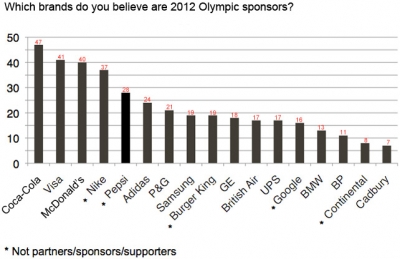
A new consumer study completed by Toluna Global Omnibus illustrates that consumer awareness and recall of what companies are Olympic sponsors and advertisers is surprisingly low.  The graph below illustrates the brand recall by company (unclear if this is aided or unaided awareness):

There are two notable take-aways from the data above.

  1. 5 of the top 16 companies (including 2 of the top 5) got credit for being a sponsor without actually spending a dime on Olympic advertising
  2. Even Coca-Cola, the brand with the most recall, has shockingly low awareness of sponsorship, with less than 50% of consumers aware of the linkage to the Olympics, and 28% of consumers crediting their ads back to primary rival Pepsi
These data points bring two thoughts to mind, first the investment in sponsorship doesn't seem to equate to a considerable amount of revenue upside.  Second, brands are really doing a bad job of differentiating their advertisements and breaking through to drive recall.  

I posted a few days ago about how many Olympic ads all seem to blend together, so check that post out if you haven't and watch the three example ads in that post.

Thursday, July 12, 2012

Is Pepsi the "next generation" of yogurt?

Early this week Pepsi announced it is entering the Yogurt market via a joint venture partnership with German dairy company Theo Müller.  The joint venture will be run as the Müller Quaker Dairy and called Müller by Quaker and will begin by being sold in the northeast US.  It appears that they will offer at least 3 different types of yogurt: conventional, Greek, and Fruit Up (fruit mousse in top of the yogurt that gets stirred in).  The yogurt will be packaged in a square contained with one corner filled with an ingredient that the consumer can mix in; including caramelized almonds, tiny chocolate-covered crunch balls and granola.
Pepsi, which in addition to its traditional beverage business also owns Quaker, Gatorade, Tropicana, and Frito-Lay, is looking to diversify its portfolio as the soda category continues to be squeezed by health trends and the company looks to jump start long-term growth.


Why Yogurt?
Yogurt offers Pepsi three advantages.  First, its a fast growing category (+9%) that outpaces traditional grocery categories as its alined with consumer health an wellness tailwinds.  Second, it gets Pepsi into a new section of the store - the dairy aisle.  And third, Pepsi could likely leverage its refrigerated Tropicana DSD network to capture significant cost scale.


Will it be successful?  
Pepsi research suggests that Americans consume ~12 pounds of yogurt a year, which is half as much as Canadians and only a third the amount of Europeans.  Pepsi attributes this gap to the US category offerings being boring vs. international offerings: “It’s been an ‘I gotta have it because it’s good for me’ kind of a product . . .The 'wanna have it' was missing” according to Dr. Mehmood Khan, who oversees PepsiCo’s global research and development and was interviewed in a recent New York Times article. According to that article, Müller by Quaker will fill the current product offering void by offering a a new variety yogurt with its own unique texture that is between Greek and conventional yogurts.  The product will be marketed under the tagline "European for Yummy".  


While General Mills (Yoplait) and Dannon make up 50% of category sales, much of the recent category growth has been driven by Greek yogurt brands Fage and Chobani.  The fact that these smaller brands have gained traction and shelf space would suggest a brand backed by a CPG manufacturer with the clout and deep pockets of Pepsi would also be able to muscle its way into the category assuming the product is truly differentiated and delicious.  It also wouldn't be surprising to see Pepsi bring its soda strategy to life in this category by supporting the brand launch with an enormous advertising budget as well as running a significant amount of promotions focuses on BOGO's and bulk discounts.  The yogurt category has seen plenty of innovation over the past several years and I believe many category consumers are willing to experiment with new brands and flavors, but the category will remain highly competitive and unlike soda its wont just be a two horse race.


In conclusion, I believe Pepsi can clearly make a splash in the category and will help fuel overall growth.  However, I have a hard time believing the brand will climb higher than a #4 share behind Dannon, Yoplait, and Private Label, and may even have a hard time in the short-term outselling some of the hot Greek Yogurt brands.  One could see the brand, perhaps, ultimately reaching a 10-15% market share over the next 3 years.