Showing posts with label McDonald's. Show all posts

Saturday, January 3, 2015

Bud Light Recycles Coke's Label Campaign

A few years ago, Coke launched its "Share a Coke" campaign first overseas and then in the US over the past summer where the brand put the 250 most popular American teen names and other millennial sayings on its labels.

Now it looks like Bud Light is taking a page out of Coca-Cola's playbook.  As part of its "Perfect Beer For Whatever Happens", Bud Light is launching new bottle labels featuring over 100 different varying messages.

Bud Light Up for Whatever Bottle

Each label touts Bud Light is the "perfect beer for ... ". 

For example:
  • "the perfect beer for when you're eating breakfast meats outside of breakfast hours"
  • "the perfect beer for forming a one-person conga line"
  • "the perfect beer for leaving your comfort zone in another time zone"
  • "the perfect beer for taking off the blindfold and showing that piƱata who's boss"
  • "the perfect beer for tuning up the old air guitar"

The messages are suppose to help position the brand around inspiring spontaneous fun. And while the messages are fun enough, they do not have the same compelling call to purchase as consumers seeing their names on a bottle or labels such as "BFF,” “Star,” “Bestie,” “Legend,” “Grillmaster,” “Buddy” and “Wingman” like Coke featured. 

Additionally, the messaging in at least one of the accompany TV advertisements fails to hit home on this core benefit because it over complicates its message by trying to communicate too many things...


The area of the campaign that has the most promise is where the brand will customize beer bottle labels sold at sporting events and concerts that allow some drinkers the chance to win random, on-the-spot prizes, such as backstage passes or other real-time rewards.

Using the beer labels as a ticket for entry into a contest or a treasure hunt is clever and I believe will be compelling enough to drive consumers at the events to purchase.  The biggest question is how much scale can Bud Light generate with event based programs and will it be enough to generate sufficient social buzz to drive a noticeable lift in sales?  The other question is why didn't the brand aim bigger?  It seems like the brand could replicate this strategy on a much large scale with a McDonald's like Monopoly game where the notion of spontaneous fun can support itself organically.

Wednesday, August 7, 2013

Does Taco Bell hate kids?

Taco Bell recently announced it plans to stop selling kids meals and toys in its restaurants at the beginning of 2014, making it the first national U.S. fast-food restaurant to kill kids meals (although west coast based Jack-in-the Box did eliminate kids meals back in 2011).


Why would Taco Bell risk alienating moms and kids?

The short answer is Taco Bell is doing a smart job of tightly targeting their consumer (the edgy millennial) and positioning its marketing and product offering to best serve that consumer. "The future of Taco Bell is not about kids meals . . . This is about positioning the brand for millennials" according to Taco Bell CEO Greg Creed.

The longer answer also includes the fact there is likely a sizable benefit to cost payout by removing the kids meals:

  • Benefit:
    • Remove operational complexity and inventory costs
    • Trade-up to a higher ticket. A kids meal with a Crunchy Taco, Cinnamon Twists and a small beverage currently costs ~$2.84 vs. $3.17 when purchased a la carte from the full menu
    • The menu space and signage can be better utilized for higher margin items
    • Marketing can be better focused on core target
    • Removes risk of lawsuits or negative PR around child obesity

  • Cost:
    • Limited as kids meals only account for half of 1% of Taco Bell's overall sales (Unlike McDonald’s where Happy Meals likely account for ~10% of sales)

So, no, Taco Bell doesn't hate kids it just loves 'edgy' millennials more and is willing to sacrifice a few consumers to do a better job targeting its core consumer.

Monday, December 17, 2012

McDonald's McRib . . . It's back!

That's right, it's back . . . McDonald's McRib sandwich returned to restaurants nationwide today.

Historically, it was up to the local franchises to decide if/when they wanted to sell the McRib – except in Germany where interestingly enough it's nearly always available.  However, the last few years McDonald's began running the McRib as a national promotion to great success and has decided to duplicate the event again this year.
Given its cult-like following and the amount of consumer excitement generated every time the McRib is re-released, some people might wonder why McDonald's doesn't just make it available on an everyday basis.

Despite its fanfare, the reality is that the sandwich does not actually sell at a fast enough velocity to justify everyday distribution.  In fact, this year's release date was originally targeted to be October 22, but McDonald's decided to delay the release due to unseasonably warm weather earlier in the fall.  That's right, McRib lovers can blame global warming for the delay.  As it turns out, McDonald's research indicates the McRib sandwich performs best in colder weather and specifically around the holidays, when evidently the appetite for pork is at its highest.

To it's credit, McDonald's has smartly realized it can use the McRib as a limited time only offer to drive traffic.  What began as a small promotion has actually turned into a brilliant marketing strategy where McDonald's effectively creates scarcity to drum up consumer demand and play to consumers' obsession for the sandwich.

And it works!  The proof is in the sandwich as well as in McRib's strong social media following on Facebook, Twitter, and even a consumer created unofficial McRib Locator website, which attempts to identify "possible" sightings of the McRib at McDonald's.

Wednesday, August 8, 2012

Who are the Olympic Advertisers and Sponsors again?

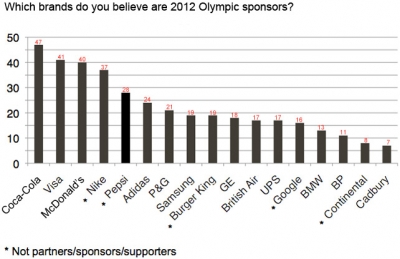
A new consumer study completed by Toluna Global Omnibus illustrates that consumer awareness and recall of what companies are Olympic sponsors and advertisers is surprisingly low.  The graph below illustrates the brand recall by company (unclear if this is aided or unaided awareness):

There are two notable take-aways from the data above.

  1. 5 of the top 16 companies (including 2 of the top 5) got credit for being a sponsor without actually spending a dime on Olympic advertising
  2. Even Coca-Cola, the brand with the most recall, has shockingly low awareness of sponsorship, with less than 50% of consumers aware of the linkage to the Olympics, and 28% of consumers crediting their ads back to primary rival Pepsi
These data points bring two thoughts to mind, first the investment in sponsorship doesn't seem to equate to a considerable amount of revenue upside.  Second, brands are really doing a bad job of differentiating their advertisements and breaking through to drive recall.  

I posted a few days ago about how many Olympic ads all seem to blend together, so check that post out if you haven't and watch the three example ads in that post.