Showing posts with label Bad TV Ads. Show all posts

Saturday, January 3, 2015

Bud Light Recycles Coke's Label Campaign

A few years ago, Coke launched its "Share a Coke" campaign first overseas and then in the US over the past summer where the brand put the 250 most popular American teen names and other millennial sayings on its labels.

Now it looks like Bud Light is taking a page out of Coca-Cola's playbook.  As part of its "Perfect Beer For Whatever Happens", Bud Light is launching new bottle labels featuring over 100 different varying messages.

Bud Light Up for Whatever Bottle

Each label touts Bud Light is the "perfect beer for ... ". 

For example:
  • "the perfect beer for when you're eating breakfast meats outside of breakfast hours"
  • "the perfect beer for forming a one-person conga line"
  • "the perfect beer for leaving your comfort zone in another time zone"
  • "the perfect beer for taking off the blindfold and showing that piƱata who's boss"
  • "the perfect beer for tuning up the old air guitar"

The messages are suppose to help position the brand around inspiring spontaneous fun. And while the messages are fun enough, they do not have the same compelling call to purchase as consumers seeing their names on a bottle or labels such as "BFF,” “Star,” “Bestie,” “Legend,” “Grillmaster,” “Buddy” and “Wingman” like Coke featured. 

Additionally, the messaging in at least one of the accompany TV advertisements fails to hit home on this core benefit because it over complicates its message by trying to communicate too many things...


The area of the campaign that has the most promise is where the brand will customize beer bottle labels sold at sporting events and concerts that allow some drinkers the chance to win random, on-the-spot prizes, such as backstage passes or other real-time rewards.

Using the beer labels as a ticket for entry into a contest or a treasure hunt is clever and I believe will be compelling enough to drive consumers at the events to purchase.  The biggest question is how much scale can Bud Light generate with event based programs and will it be enough to generate sufficient social buzz to drive a noticeable lift in sales?  The other question is why didn't the brand aim bigger?  It seems like the brand could replicate this strategy on a much large scale with a McDonald's like Monopoly game where the notion of spontaneous fun can support itself organically.

Thursday, November 7, 2013

Guinness Wheelchair Basketball Commercial

Guinness released a new TV commercial a few months ago that is outstanding on nearly every front.  It catches your attention, keeps you engages, and connects emotionally.  Like I said, outstanding on nearly all fronts.  Unfortunately, the commercial fails to link back to the brand equity for me.  Take a look.


As much as I love the ad, it just doesn't feel like a Guinness commercial to me.


Wednesday, April 17, 2013

"Happier than the Pillsbury Doughboy on His Way to a Baking Convention"

One of GEICO's new commercials features the Pillsbury Doughboy and is titled "Happier than the Pillsbury Doughboy on His Way to a Baking Convention".  Take a look...


The ad is highly entertaining and conveys positive emotions for the Pillsbury Doughboy.  My problem with this advertisement is I'd expect very low recall for GEICO.  So while it may entertain, I'd be surprised if it moved the needle much in sales for GEICO.  On the other hand Pillsbury might expect to see a nice little halo from the commercial as it allows consumers to connect with the Doughboy.

GEICO Dough Boy commercial - Pillsbury Doughboy scores, GEICO loses

Monday, February 4, 2013

More Super Bowl Commercial Thoughts...

After a day of reflecting on the best Super Bowl ads, I'd still argue that from a marketers perspective the M&M and Best Buy commercials were two of the best.

My assessment is based on a mix of how effective I think the commercial is across three dimensions:
  1. Grabs you're attention and entertains - nearly all Super Bowl ads did this
  2. Sells a clear product benefit that links with the brand equity
  3. Strong brand recall (e.g., you actually remember what brand the ad was from)
While many other of the Super Bowl ads did a good job across one or two of these dimensions, few delivered strongly against all of them.  

Some of the best of the rest:

Mercedes-Benz's Soul super bowl commercial

Tide's Miracle Stain super bowl commercial


Samsung's The Next Big Thing super bowl commercial


The other interesting thing to note was how many advertisers chose to go with a long-format spot versus the standard 30 second ad.  There were at least 5 commercials that pushed 90 seconds as advertisers took advantage of a captive audience to tell their stories and seek to connect with consumers in new ways.

Friday, September 7, 2012

Axe. Hair. It's What Girls See First

Axe is back at it again with a new controversial tv ad focused on its hair care products.

The ad tells a story of a budding office romance by showing a man represented by a cartoon of a man's hair and a women represented by a cartoon of a women's chest to play up the importance of the fact that hair is the first thing women notice in a man, just as the stereotype would be a woman's chest is the first thing the man notices.  Take a look...


I admit that I'm not the target for this ad as it is clearly focused Axe's prime prospect of teenaged boys.   Nevertheless, I do not think the ad is highly effective for a few reasons.  First, while it catches a viewers attention with its unique imagery of a women's chest, it's confusing and the viewer has to figure out what's going on and why.  Second, the ad is very weak in terms of branding and doesn't sell me on why Axe is uniquely positioned to help win the girl.

Wednesday, August 29, 2012

Avis No Longer Tries Harder

Avis recently announced that it was overhauling its brand strategy by retiring  its infamous tagline "We Try Harder" after over 5 decades and replacing it with the new tagline "It's Your Space".

The move is being pioneered by Avis' new CMO, Jeannine Haas, whose prior work experience includes stints at American Express and Ford Motor Co.  In a recent interview Jeannine explained the move by saying "Consumer-centric brands must always evolve in order to keep pace with ever-changing customer needs and preferences . . . Avis is evolving as a premium brand to better meet those needs. . . [the goal of the re-branding is to be] reflective of [Avis'] ongoing mission to be a customer-led, service-driven company, and presents the brand in terms of the customer experience and the advantages inherent in renting from Avis"


The new tagline, "It's Your Space", is supposedly targeted at business travelers and hypes up the fact that business travelers can recharge or be productive in the sanctuary of the car cabin. Avis' website even says, "With Avis it's more than a rental. It's your space."

My first reaction to this new marketing and brand strategy was it is a bad idea, my second reaction is its an AWFUL idea. . . Now I have no doubt that Jeannine and her marketing did plenty of consumer research that indicated "We Try Harder" doesn't resonate anymore with consumers.  But being customer-centric doesn't always mean taking what the consumer says literally.  My guess is that the essence behind the tagline is just as relevant as ever, it's just the customer experience has drifted far from this ideal.

In my opinion, "We Try Harder" is not just a tagline, it's a deep part of the brand's DNA and an important part of the consumer equity.  As a opposed to moving away from "We Try Harder", Avis should have doubled-down behind it - proving to consumers in this day and age how the customer experience is noticeable different, noticeable better because of Avis trying harder to please their consumers.  It's about having more agents, more smiles, more consumer choices, more flexibility, shorter lines, and fewer fees.  It's unique, it's ownable, it differentiates the brand from the other car rental companies.


An old "We Try Harder" commercial:


New "It's Your Space" commercial:


The new tagline, "It's Your Space" glorifies the car, which is nothing more than a commodity in this business.  The ad is generic, it could be for any car company.  It moves the brand to a place that's no longer unique in the American landscape.  My guess is this re-branding effort will be shorter lived than the new CMO can imagine and "We Try Harder" will be re-instated to its rightful place as a classic American tagline.

Wednesday, August 8, 2012

Who are the Olympic Advertisers and Sponsors again?

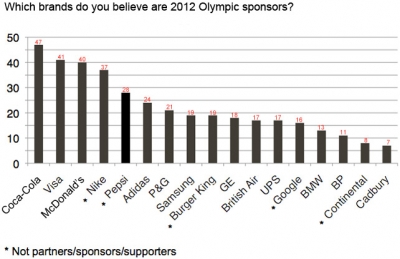
A new consumer study completed by Toluna Global Omnibus illustrates that consumer awareness and recall of what companies are Olympic sponsors and advertisers is surprisingly low.  The graph below illustrates the brand recall by company (unclear if this is aided or unaided awareness):

There are two notable take-aways from the data above.

  1. 5 of the top 16 companies (including 2 of the top 5) got credit for being a sponsor without actually spending a dime on Olympic advertising
  2. Even Coca-Cola, the brand with the most recall, has shockingly low awareness of sponsorship, with less than 50% of consumers aware of the linkage to the Olympics, and 28% of consumers crediting their ads back to primary rival Pepsi
These data points bring two thoughts to mind, first the investment in sponsorship doesn't seem to equate to a considerable amount of revenue upside.  Second, brands are really doing a bad job of differentiating their advertisements and breaking through to drive recall.  

I posted a few days ago about how many Olympic ads all seem to blend together, so check that post out if you haven't and watch the three example ads in that post.

Tuesday, August 7, 2012

"There's nothing soft about it" - Sprite, really?

Sprite just launched a new marketing campaign using the tagline "There's nothing soft about it", targeting teens (my guess urban teens).  The campaign is built around the product's "intensity" and the first ad even starts with the line "This is way more intense than I was expecting!" 


While I understand the want to have a brand equity built around being intense and bold - especially for an urban teen consumer target, I think it's a bit of a strange place to take Sprite because the product profile doesn't seem to match the positioning.  Is it me, or is Sprite one of the most vanilla of beverages in terms of the flavor profile being very traditional vs. edgy?  

Given the fit with the product taste profile is a big question, I have bigger doubts on the impact of the message - just because you say your intense doesn't mean people will believe it.  The other issue I see with this new positioning is it seems to conflict with the historical brand position of being ultra refreshing.  Intense might be good in consumers' minds, but I doubt there is much overlapping association between intense and refreshing.  Net-net, I might be proven wrong in the long-run, but I think this rebranding is just a poor fit and consumers will struggle to give Sprite permission to play as an "intense" brand.

Saturday, August 4, 2012

Olympic Ads Tug the Heart, but Have No Recall

I posted earlier about how P&G's olympic ads tug at the heart, but I would expect them to have limited brand recall...here's the ad I referenced

Well, I'd conclude that many other Olympic advertisements are brilliant creative, but ultimately all have the same problems...

Here's my favorite of the Citi Olympic Ads:

Again, it's brilliant creative, no doubt, I just doubt few consumers will walk away remembering it was a Citi ad.

Likewise, the creative in this Visa Ad is great...

...and Morgan Freeman nails the voiceover, but really at the end of the day all of these ads have to be running together in consumers minds

Friday, August 3, 2012

Why is Proctor & Gamble advertising P&G?

As a former P&G marketer I'll admit that I have a lot of P&G loyalty, but every time I see one of the P&G Olympic advertisements I scratch my head.  It's not because I don't like the ads, you have to be heartless not to feel the emotion when they air the "Thank You, Mom" campaign...


...it's just I want to understand the end game for P&G.  There's no doubt the ads are emotionally moving, but the brand recall is all about P&G a large corporation that consumers have no emotional connection to, as opposed to say Pampers or Tide, which have a ton of emotional equity built up in the hearts and minds of consumers.

In short, I want to know what is the company's long-term strategy.  I say long-term because if the company was just trying to boost sales of its current business, there's no doubt it would have a higher ROI throwing this money behind an ad that builds up one of its leading billion dollar brands.

Such as these ads:


If I had to guess, the logic is that the overarching ads focused on P&G provide the backbone of the campaign and help tie all the individual brand ads together, but I'd actually suggest that the overall ad dilutes the individual brand ads because at some point they all start blending together in the consumer's mind.  Either way, its tough to try to build an emotional connection between a billion dollar conglomerate, and even if you do, then you still have the uphill battle of educating consumers on which brands are even made by the company.  Love the "Thank You, Mom" ads from a heart strings standpoint, but have a tough time believe its providing the company the biggest bang for its buck

Friday, June 15, 2012

Only a Honda is a Honda, or is it?

Honda has recently launched a TV campaign trying to differentiate Honda from it's competitors with the tagline "Only a Honda is a Honda". The tagline is great, but does it really say anything? Or is it trying to draw a point of differentiation where none exists?

Honda rose to prominence in the U.S. in beginning in the 1970's with an equity built around affordable, dependable, and fuel-efficient cars. This strategy helped differentiate it from the American Big 3 and win market share. At the same time, Honda was able to separate itself from its compatriot, Toyota, because it leveraged a slightly sporty look supposedly born from its founder's racing history.

Fast forwarding to 21st millennium, American, European, and Korean cars have all essentially caught up with Honda/Toyota's reliability and fuel efficiency - essentially eliminating a big portion of what had made Honda a Honda historically. Not only that, but the Korean car manufacturers have enhanced the pressure on Honda/Toyota by continuing to undercut price, while offer a superior warranty and even including some historic luxury items in at base prices - thus creating a highly competitive value equation to help overcoming their weaker historic brand equity. Thus not surprisingly, Honda’s U.S. sales which were more than doubled the combined U.S. sales of Hyundai and Kia as recently as 2007, were only 1 percent higher last year.

So, when Honda says "only a Honda is a Honda" in their latest TV ads its moving into damage control mode.

While the ads don't mention any competitors by name they do make remarks implying that Honda is still the most reliable car on the market. For example one line claims that just because the competitor's warranty is reliable, it doesn't make the car dependable - clearly a reference to Hyundai's famous 10 year warranty. However, it's notable that Honda makes these assertions in a very vague and understated fashion - suggesting it may no longer have the ability to legally claim superiority. While Honda's brand equity gives it a reservoir of credit when it comes to dependability, the gap to all other car companies will continue to deteriorate as other manufacturers catch up. Thus, Honda must look to evolve its point of differentiation in order to remain a leader in the long-run.